Then / Now / Next: Ecologist Lenya Quinn-Davidson is rethinking California’s relationship with fire
The UC Berkeley alum is growing fire resilience across the state through prescribed and cultural burning, policy work and community building.
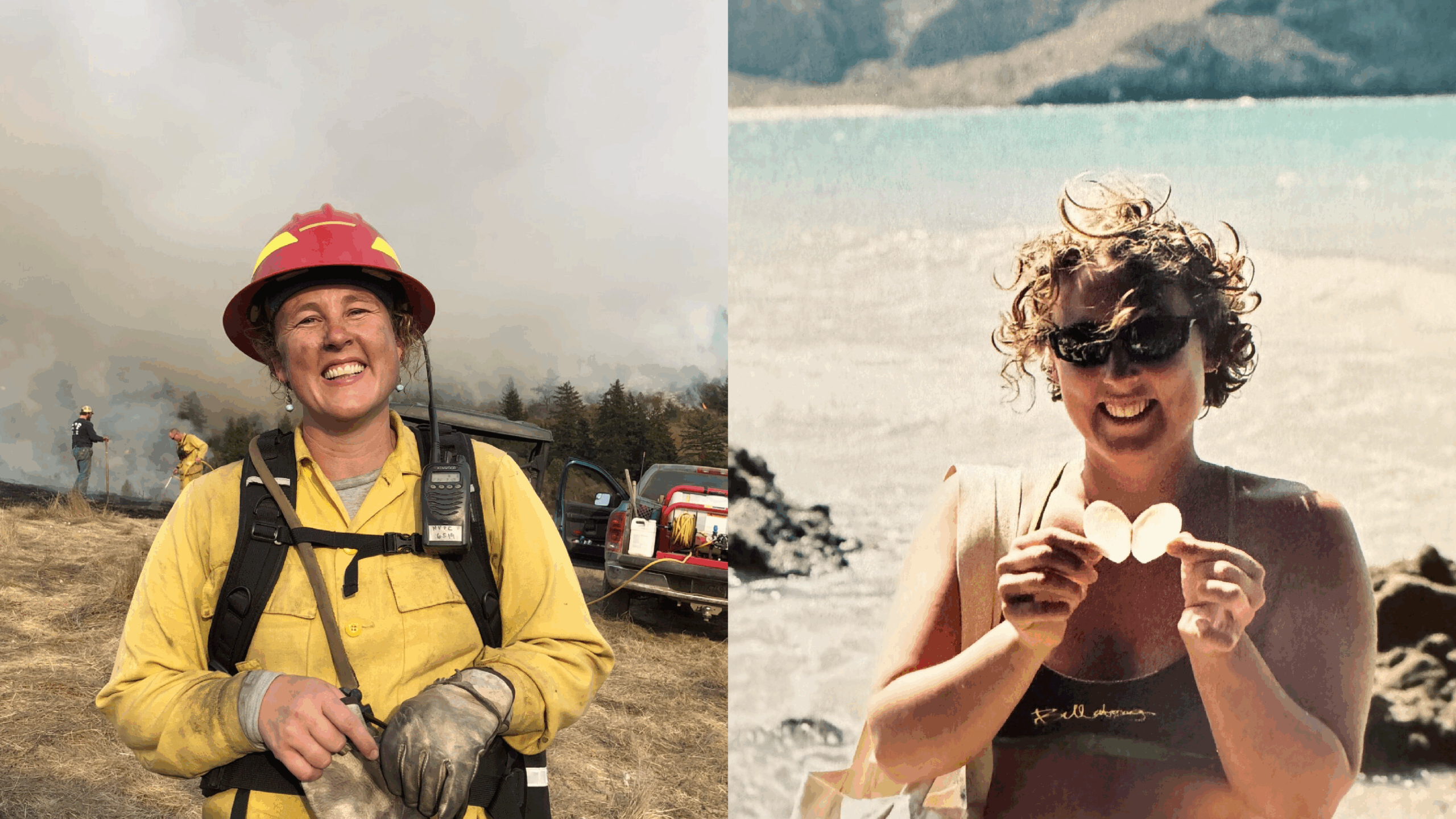
Photos courtesy Lenya-Quinn Davidson
December 1, 2025
Fire touches every Californian. From the Pacific Palisades to the Sierra Nevada, entire communities have watched skies turn orange, breathed weeks of smoke, or known families forced to flee.
Lenya Quinn-Davidson (BS ‘04, Conservation and Resource Studies) has spent her life facing that reality head-on. As a fire ecologist and director of the University of California Agriculture and Natural Resources (UCANR) Fire Network, she advances prescribed and cultural burning across the state through community work, practitioner training, and policy efforts that protect and support the people doing this work.
A 2004 graduate of UC Berkeley’s College of Natural Resources, she brings an interdisciplinary mindset — and a spark of the radical “question everything” spirit that runs in her family — to a field that blends science, policy, and community trust.
This conversation is part of Then / Now / Next, our #CalAlumStory series celebrating how UC Berkeley graduates are shaping the world: past, present, and future.
Then: Berkeley beginnings and roots in fire

Photo courtesy Lenya Quinn-Davidson
Tell us a bit more about these photos. Were you always interested in fire and ecology?
This photo shows me, my sister and my dad in the Trinity Alps. We lived pretty close to this wilderness area and used to go backpacking there every year as a family. It’s an area that’s very, very fire prone. And as a kid, I was pretty scared of fire. I thought it was scary and bad; at that time, it was not something I was drawn to.
You grew up with fire all around you. What changed your fear?
At Berkeley, I took fire ecology and forest ecology classes and that’s when it all started to click for me — that fire is a natural process and maybe it’s not so bad. I started to realize that maybe the problem is that we’ve kept fire out of these places that need it. My time at Berkeley really redirected my interests and helped me see my home landscape through new eyes.
What led you to Berkeley?
I’m third generation at UC Berkeley. My dad grew up in the Bay Area, and both of his parents went to Berkeley. Their siblings went to Berkeley. He and his brother went to Berkeley, and my uncle actually played college basketball there. My grandmother studied music and Latin there back in the late 1920s, which must have been so rare for women at the time. Cal has always been a big part of our family.

Photos courtesy Lenya Quinn-Davidson
Any Berkeley professors or mentors who left a lasting mark on you?
One of the professors in my first couple of years who influenced me was the late Don Dahlsten, an entomologist in the College of Natural Resources. He hosted a field-trip class where you would go out to somewhere cool, normally a UC property — Blodgett Forest Research Station, Hopland Research and Extension Center, Kearney Agricultural Research Station, and Point Reyes Field Station. We spent the whole semester going to these amazing places, learning about the variety of work that people were doing across the UC system.
Another class that I really loved was a geomorphology class with Bill Dietrich. We went to the Tahoe Basin and mapped historic glacier extent. It changed the way I thought about the landscape and the longer timeframes of how places are shaped and formed.
Later in my time there, Scott Stephens rose to the top for me and shaped how I thought about fire. He’s a fire scientist in the College of Natural Resources and still there. He and I are close collaborators now with the University of California in my current position, and it’s been fun to have that relationship come full circle.
Many of the environmental problems we have in the world are at their heart social problems. The nice part about social problems is that they’re within our power to fix.
Tell us more about being an undergrad at Rausser College of Natural Resources.
My major at Berkeley was Conservation and Resource Studies, which is kind of a build-your-own major where you choose classes that seem really disparate and then weave together a theme. Mine was focused on watershed restoration. That’s why I took fire science, forestry, geomorphology, lots of geography classes — and wove those all together into this restoration-focused major that was very interdisciplinary.
It serves me well now, because in my job we’re always working across different peoples, politics, and ecologies. It’s benefited me to have that interdisciplinary background that I started at Berkeley.
You’ve called yourself a rule breaker. Did that start during your Berkeley days?
Our family was pretty countercultural when I was growing up. On some level maybe that did come from my dad’s time as a student at Berkeley in the ’60s. He thought we shouldn’t feel bound to social norms in the way we think about fixing problems.
In my work, I think we sometimes need to change the system or build alternate systems if the current system isn’t working. There’s a lot of groupthink that happens in fire management that doesn’t serve us well. I like to think about innovative solutions to these problems and new ways of thinking and doing.

Photo courtesy Lenya Quinn-Davidson via @WTREX Instagram
Now: Redefining how California lives with fire
Your work is just as much about people as it is about science. What have you learned about building community trust around fire?
Many of the environmental problems we have in the world are at their heart social problems. They result from choices that people have made that have not served us well, or are long-lasting threads from the disenfranchisement or colonization of people who were long doing better things in California around fire.
The nice part about social problems is that they’re within our power to fix. We can rebuild our relationship and change how we interact with fire. A lot of my work is about engagement, reconnecting people with place and the idea that fire has always been a human practice. An integral part of being Californian is having a connection to fire.
What recent projects or programs are you most proud of?
In 2017, my colleagues and I brought the Prescribed Burn Association (PBA) model to California from the Great Plains. PBAs are community cooperatives that plan and implement prescribed fire on private lands. We founded the first PBA in Humboldt County in 2017, and now we have more than 30 prescribed burn associations around California. It’s been amazing to see the momentum. I call it a social movement because there’s so much energy and coming together around prescribed fire.

Photo via @WomensTrex Instagram
The other program I am proud of is called the Women-in-Fire Prescribed Fire Training Exchange Program (WTREX). It’s an international program that focuses on providing training opportunities, mentoring, and support networks for women and others who work in fire. It’s not exclusive to women, but it has a focus on women’s leadership and a real focus on changing the culture of fire.
I also do a lot of policy work to provide more protection for cultural burners and prescribed fire practitioners here in California. This work is clearly in service of public benefit, but historically the practitioners have taken on all the liability themselves, and that’s not fair.
My colleagues and I worked closely with the late Senator Bill Dodd over the last several years to change the liability context for beneficial fire in California. In 2021, we changed the state’s liability standard, providing protections for prescribed burners and cultural fire practitioners. And in 2022, we passed a bill that established a $20 million claims fund, which fills the insurance gap for this work. It’s been a really remarkable few years for this work.
People and policy go hand in hand. What was the unlock in this partisan world?
With SB332, the bill that changed the liability standard, the key partners were the Karuk tribe, which has been a real leader in policy work, but also the California Cattlemen’s Association and some environmental groups like Defenders of Wildlife and Save the Redwoods League.
One of the really cool things you see is these often disparate groups coming together with a shared vision for a better relationship with fire. It’s been this beautiful interdisciplinary, cross-political space. That’s my favorite place, working with different kinds of people, bringing different perspectives. It’s non-partisan and really inspiring in that way.
What do you want people to know about fire?
Every part of California that we know and love has a fire story to tell. Fire is always going to be here, so we need to learn to live with it and to leverage it for good. We need to seize on the opportunity to help shape what that relationship with fire looks like. It doesn’t always have to be scary and negative and catastrophic. It can also be inspiring and positive and connecting. That’s the work I do.

Photo via @WTREX Instagram
Next: Living with fire and inspiring change
What’s one piece of advice for the next generation who want to care for the land?
I’m a big fan of rethinking. If there’s something you really think that you know, seek out different perspectives and question it. The impetus for most of the programs I lead is this rethinking, which helps find some of your blind spots and highlight new solutions. It’s a valuable thing for any academic, but also any person to be comfortable with discomfort and not knowing or relearning things.
You’re definitely a rule breaker. Maybe you’re also a rule maker.
[laughs] Maybe so. Question authority, yes. I’ve always loved to question authority. But also, remember the bumper sticker that’s like, “Don’t believe everything you think” — you find some of your most innovative thinking when you go outside of those boxes.
This interview has been condensed and edited for clarity.
Want to learn more about Lenya’s community fire programs or take action where you live? Start here:
University of California Agriculture and Natural Resources Fire Network: Resources on wildfire, prescribed fire, home hardening, and defensible space.
California Prescribed Burn Associations: Find local, community-led burn groups across California.
Women-in-Fire Prescribed Fire Training Exchanges: Global training and mentorship for women in fire leadership.